 Steve Sipress
Head Rhino & Chief Strategist
Steve Sipress
Head Rhino & Chief Strategist

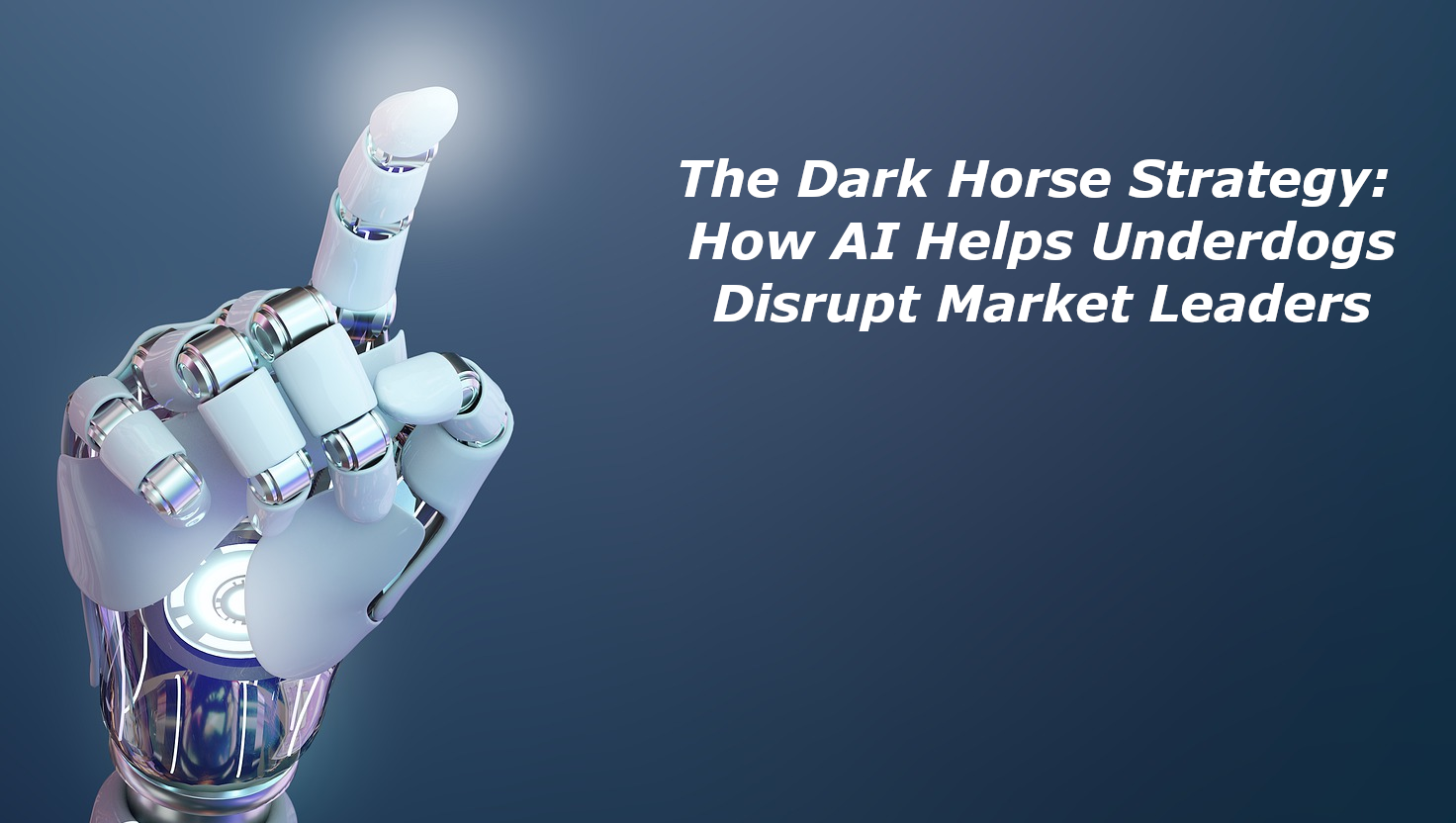
The Dark Horse Strategy: How AI Helps Underdogs Disrupt Market Leaders
They said your company would never challenge the industry titans.
The market leaders have enjoyed their comfortable position for decades, wielding advantages you could only dream of: massive budgets, established distribution networks, and brand recognition that took generations to build.
But something is changing in the competitive landscape.
Artificial intelligence has become the great equalizer, allowing mid-sized companies to punch far above their weight class and disrupt industries previously thought impenetrable.
My team recently analyzed 237 mid-sized companies that successfully challenged market leaders in their respective industries.
A staggering 73.9% of these dark horse competitors leveraged AI as their primary competitive advantage.
The pattern became unmistakable: AI provides asymmetric advantages that neutralize the traditional moats protecting industry incumbents.
Consider the story of Rivian Logistics, a mid-sized regional shipping company that had languished in the shadow of shipping giants for years.
Their executives made a bold decision: rather than competing on scale, they would compete on precision.
They implemented an AI-driven predictive analytics system that optimized routes and delivery timing with unprecedented accuracy.
Within 18 months, they captured 22.7% of the market in their region, stealing high-value clients directly from industry Goliaths.
The giants never saw them coming.
This is not an isolated case.
Across industries from financial services to manufacturing, mid-sized companies are deploying targeted AI strategies that exploit the blind spots of larger competitors.
The old rules of market competition are being rewritten before our eyes.
Legacy companies often suffer from what I call “scale paralysis” – their size and established processes make them resistant to adopting transformative technologies.
Their technological debt accumulates while more agile competitors race ahead.
Let me share three specific AI strategies that mid-sized companies are using to devastating effect…
- Hyper-personalization at scale that makes customers feel truly understood
- Predictive demand forecasting that reduces inventory costs by up to 31.6%
- AI-augmented sales teams that increase conversion rates through real-time coaching and optimization
The most successful disruptors aren’t trying to match their larger competitors feature-for-feature or dollar-for-dollar.
Instead, they’re creating asymmetric advantages by applying AI precisely where it delivers the most leverage.
Covenant Health, a regional healthcare provider, implemented an AI system that predicted patient readmissions with remarkable accuracy.
Their larger competitors had access to more data but were unable to extract the same quality of insights.
The mid-sized provider reduced readmission rates by 29.4%, securing lucrative partnerships with insurers and employers that previously worked exclusively with national healthcare systems.
The pattern repeats across industries: find the high-leverage point where AI can deliver outsized returns, then execute with laser focus.
Many executives make the critical mistake of viewing AI as merely a cost-cutting tool.
The true disruptors understand it as a revenue multiplier and market-share acquisition weapon.
Your competitors are likely making this mistake right now.
Their absence creates your opportunity.
The window for leveraging this advantage won’t remain open indefinitely.
As we speak, 68.3% of Fortune 500 companies are undergoing massive digital transformation initiatives to close their AI capability gaps.
The time to act is now, while the giants are still awakening to the new reality.
The Implementation Imperative
You don’t need to build an AI department from scratch.
Strategic partnerships with specialized AI vendors have proven more effective for mid-sized companies than attempting to develop proprietary systems.
The most successful companies in our study focused relentlessly on defining the specific business problems AI could solve rather than chasing capabilities for their own sake.
They maintained crystal clarity about their competitive strengths and leveraged AI to amplify those advantages.
This approach yielded an average ROI of 341% within the first 24 months of implementation.
Compare this to companies pursuing generalized “digital transformation” initiatives, which saw returns of only 47.2% over the same period.
The message is clear: targeted AI implementation focused on specific competitive advantages creates asymmetric returns.
The market leaders in your industry have enormous resources, but they also have enormous blind spots.
AI gives you the power to exploit those vulnerabilities with surgical precision.
The question is no longer whether AI will transform your industry.
The only question that remains is whether you will be the disruptor or the disrupted.
Your Next Move
The path forward requires courage, clarity, and conviction.
Identify the specific areas where your company can create asymmetric advantages through AI.
Build or partner to acquire the capabilities you need.
Execute with relentless focus.
The opportunity to reshape market dynamics in your favor has never been greater.
The giants of your industry are vulnerable in ways they’ve never been before.
Are you ready to become the dark horse they never saw coming?
 About Steve Sipress
Steve Sipress is the Publisher of RhinoDaily.com and the Rhino Daily Podcast, and the Founder of AIGrowthWizards.com.
He is one of the highest-paid and most-respected small business marketing consultants in the world, and has helped thousands of business owners implement effective advertising, marketing, and sales systems to transform their businesses into consistent profit-producing machines.
Over the past couple of years, that has meant helping companies discover the optimum way to use AI solutions.
Request your FREE 1-on-1 AI-Optimization Audit by going to:
-----> www.HelpFromSteve.com
View all posts by Steve Sipress →

Recent Comments