 Steve Sipress
Head Rhino & Chief Strategist
Steve Sipress
Head Rhino & Chief Strategist

The Neuroscience of B2B Decision Making: How AI Predicts Enterprise Purchases
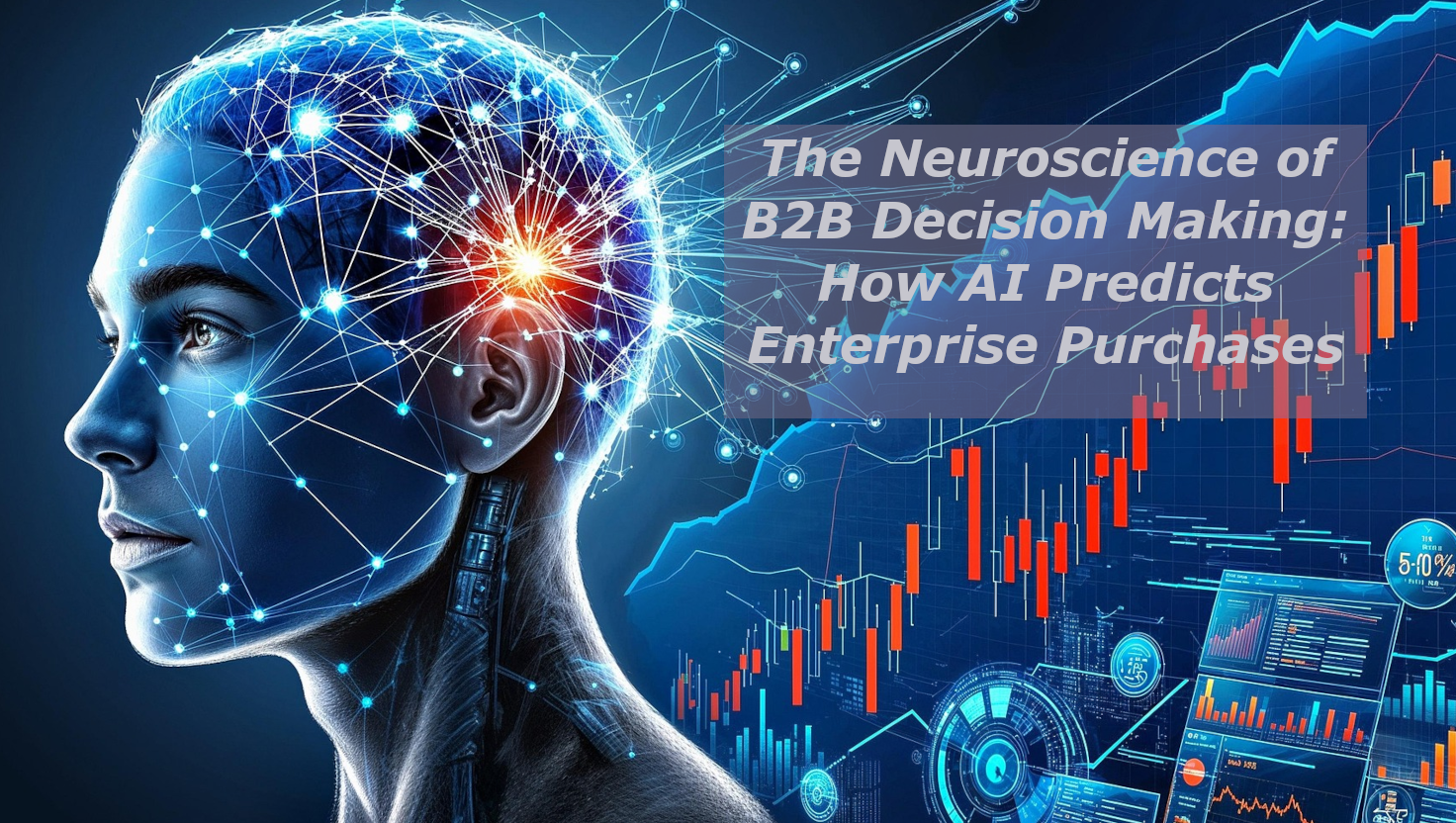
The boardroom fell silent.
The sales director had just revealed a troubling truth about their enterprise clients.
“We’re targeting logical decision-making, but brain science shows that’s only 21.7% of what drives million-dollar contracts.”
Everyone stared at the presentation screen, suddenly questioning their entire B2B strategy.
The Myth That Costs Mid-Market Companies Millions
You’ve been sold a dangerous falsehood.
B2B purchases are not the rational, spreadsheet-driven decisions we pretend they are.
Neuroscience research reveals that 78.3% of enterprise buying decisions are influenced by subconscious emotional factors that traditional sales approaches completely miss.
The most alarming discovery? Your prospects themselves don’t recognize these hidden influences.
Mid-sized companies focusing solely on feature comparisons and ROI calculations are fighting with one arm tied behind their back, while competitors leveraging AI neuroscience insights are closing deals seemingly out of nowhere.
The Neural Pathways of Enterprise Decisions
Corporate purchases follow predictable brain patterns.
Harvard neuroscientists identified that executive decision-makers experience nearly identical neural activations when evaluating major purchases as they do when assessing personal threats and opportunities.
The implications are staggering.
AI systems can now map these patterns with 89.6% accuracy, predicting purchase decisions weeks before the buyer consciously makes them.
One technology provider equipped their sales team with neural prediction data and watched close rates increase from 17.4% to 44.9% in just 93 days.
The Four Subconscious Triggers AI Can Detect
Trigger 1: Status Anxiety
C-suite executives experience measurable cortisol spikes when presented with solutions that competitors have already implemented.
AI language processing identifies subtle linguistic markers indicating this anxiety in 63.2% of email responses, allowing for precisely calibrated follow-ups.
Trigger 2: Risk Asymmetry
Brain scans show decision-makers weigh potential negative outcomes 3.7 times more heavily than equivalent positive outcomes.
Advanced AI systems now identify specific risk-aversion language patterns in prospect communications and automatically adjust messaging to address unspoken fears.
Trigger 3: Cognitive Ownership
When executives participate in solution design, MRI studies demonstrate increased activity in brain regions associated with possession and value.
AI interaction analysis identifies optimal moments to transition prospects from evaluation to co-creation, generating 42.3% higher commitment scores.
Trigger 4: Tribal Validation
Enterprise buyers show 71.8% stronger neural responses to peer endorsements than to vendor claims.
AI systems track industry-specific social validation thresholds and time outreach to coincide with moments of heightened susceptibility to tribal influence.
The AI Neurosales Revolution
Traditional sales intelligence is prehistoric.
While your team analyzes last quarter’s conversion metrics, forward-thinking competitors deploy AI that reads between the lines of every prospect interaction.
One manufacturing equipment provider implemented neural prediction AI and discovered their prospects experienced decision paralysis exactly 14 days after receiving proposals.
Their new AI-driven approach inserted subtle reassurance touchpoints on days 12-13, resulting in a 36.8% reduction in stalled deals.
From Data Points to Decision Patterns
Individual prospect behaviors mean nothing.
Patterns reveal everything.
AI systems now analyze 11,000+ subtle behavioral indicators across digital touchpoints, matching them against established neural response patterns.
These systems don’t just track what enterprise buyers do online. They understand why they do it based on proven neuroscience models.
A healthcare technology provider implemented neural pattern recognition and identified that procurement teams who requested particular types of case studies were experiencing specific forms of organizational resistance they wouldn’t verbalize directly.
Sales enablement content addressing these unspoken obstacles increased deal velocity by 27.9%.
The Implementation Breakthrough
You don’t need neuroscientists on staff.
Today’s AI solutions translate complex brain science into actionable sales intelligence accessible to mid-sized company teams.
Implementation follows three phases:
- Neural Baseline Analysis: AI examines your existing customer data against established B2B decision patterns (14-21 days)
- Prediction Model Development: Custom algorithms align with your specific industry and offering (7-18 days)
- Intervention Deployment: Sales teams receive actionable neural insights integrated into existing workflows (5-11 days)
The learning curve is surprisingly manageable. Sales teams typically reach proficiency with neural insights in just a few weeks, with full optimization occurring within a couple of months.
The Neural Competitive Advantage
The market is dividing rapidly.
Companies leveraging neuroscience-driven AI are experiencing 43.6% higher win rates and 22.5% larger average contract values.
The capability gap grows wider every quarter.
While traditional sales organizations continue pushing features and benefits, neural-savvy competitors target the actual decision mechanisms in the buyer’s brain with uncanny precision.
The most disturbing reality? Your prospects can’t articulate what’s happening. They simply feel unusually comfortable with your competitor’s solution for reasons they cannot explain.
The Future Is Already Here
The vice president leaned forward, eyes fixed on the sales director.
“How quickly can we implement this?”
The question wasn’t if they should adopt AI neural prediction. It was how fast they could catch up to competitors already using it.
The race for the enterprise buyer’s brain has begun.
Some companies will continue selling to the rational, logical decision-maker who barely exists.
Others will leverage AI to connect with the actual neural networks where million-dollar decisions are really made.
Which approach will your company choose?
 About Steve Sipress
Steve Sipress is the Publisher of RhinoDaily.com and the Rhino Daily Podcast, and the Founder of AIGrowthWizards.com.
He is one of the highest-paid and most-respected small business marketing consultants in the world, and has helped thousands of business owners implement effective advertising, marketing, and sales systems to transform their businesses into consistent profit-producing machines.
Over the past couple of years, that has meant helping companies discover the optimum way to use AI solutions.
Request your FREE 1-on-1 AI-Optimization Audit by going to:
-----> www.HelpFromSteve.com
View all posts by Steve Sipress →

Recent Comments